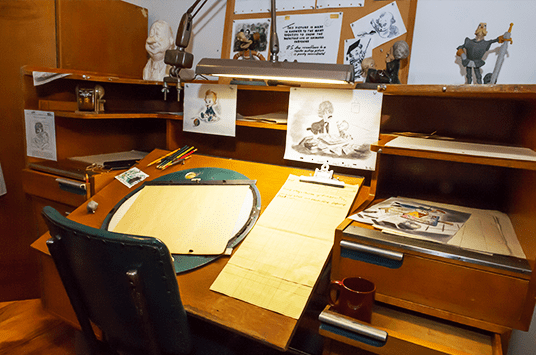
I love animation, and you should too.
Animation is my favorite kind of sorcery, stranger. On a blank celluloid sheet (or the blank canvas inside a computer program) absolutely anything can unfold. Impossible things look possible in a drawn world. After all, why would a drawing of a flying pig look any “less possible” than a drawing of a normal pig? The laws of physics pay rent to comedy and coolness, and animators make their own rules for anatomy from scratch. Characters can be hit by a train, flatten like pancakes, peel themselves off the tracks, and walk away like nothing happened. No safety nets, no wires, no weary stunt doubles.
The characters and the worlds they inhabit are not bound by the same constraints as live-action. In animation, toys and home appliances can come to life, and every backdrop is tailored to the exact shape and color a scene requires. The setting is just as “alive” as everything else the animators drew, and just as under their control. Every raindrop and blade of grass and the exact shade of gold tinting the sunrise was made so deliberately. And characters' emotions are telegraphed with absolute clarity because animators have total control over facial features and body language, and voice actors often exaggerate the emotion in their delivery. Even the most fantastical, special-effects heavy live-action is tethered to the stubborn truths of reality (if only through the presence of its actors). But animation shows you what could be, what should be, what dares to be when imagination kicks reason out of the driver’s seat and takes the wheel despite not having a license.
If the real world demands we be grounded and reasonable, animation dares be larger than life and reminds us that life is larger than we think. And I love it for that. I love it because those drawings are almost more alive than I am, and I think that’s beautiful.
Let me tell you all about it, starting with some basic definitions:
- Animation:
- A movie, scene, or sequence that simulates movement from a series of still frames (such as drawings, computer graphics, or photographs of inanimate objects moved incrementally).
Isn’t that curious? The whimsical wonder of drawings that could move and make noise as if they’d come alive was what captivated me about the art form since childhood, but at no point is the drawing itself moving. Instead, the audience is shown several static drawings in quick succession and their brains interpret that as movement.
The optical illusion of apparent motion of at least two stimuli (A and B) which appear in succession at intermediate frequencies, but are perceived as the motion of a single object (A into position B) is called beta movement. It might not be the whole story, though. Before beta movement gained traction as an explanation, it was believed that a biological quirk called retinal persistence was the reason behind how our brains interpret animation. Retinal persistence causes images to persist for about 1/16th of a second after they’ve been taken away, and if the removed image was replaced by another image, then the two images will effectively be merged by the brain. Whatever the reason, the takeaway is this: we see a sequence of static pictures where an object or character has slightly moved on each picture and our brains go “Wow, it looks like it is moving!”
There are three main techniques for creating animation.
- 2D animation is so named because drawings create the illusion of movement in a two dimensional space. Can be “traditional animation” (also known as classical animation, hand-drawn animation, and cel animation) where each and every frame is drawn and colored by hand, though modern mainstream 2D animation production has evolved to implement digital techniques using computer software.
- Stop-motion animation uses physical objects ranging from puppets; clay models (a subgenre known as “Claymation”); or cutouts made out of paper, cardboard, or cloth (a subgenre known as “Cut-Out animation”). These objects are moved in small increments, then photographed individually. These photographed frames are moved in a continuous sequence to create the illusion of motion. There are some more niche methods, such as sand animation, which involves applying sand into a lightbox and then the animators start rendering images and drawing figures on it, capturing each one independently with overhead projectors to create animation. “Physical object is moved by hand and photograped” is the main takeaway of this technique.
- 3D animation employs computer-generated imagery (CGI) to render three-dimensional objects and environments. Instead of using drawings to showcase motion, this technique leverages the use of technically proficient tools such as 3D modeling software to export 3D picture sequences that create the illusion of motion in the eyes of the viewers. Despite Stop Motion being three-dimensional, the term “3D animation” near-exclusively refers to CGI animation.